

Learn how we are working to transform how we use and produce energy.
Indonesia’s Just Energy Transition Partnership (JETP)
A Retrospective of Progress and Navigating Changes
Why we share this work for free
RMI is an independent nonprofit working to accelerate the clean energy transition. We publish research like this to inform decision-makers and drive real-world impact.
Our work is supported by philanthropy as well as partnerships, including fee-for-service engagements. This support makes it possible for us to share our independent insights for free.
If you find this work valuable, you can support it anytime.
Get more insights like this
Stay up to date with the latest research, analysis, and tools from RMI by opting in to receive occasional emails below. You’ll get new reports, event invitations, and practical insights to help us all accelerate the clean energy transition.
Loading form...
Your download should start automatically. If it doesn’t, click the download button below.
This work is made possible by philanthropy
RMI is a nonprofit supported by donors and partners. Philanthropy enables us to produce independent research and make resources like this freely available.
If you find this report valuable, please consider supporting our work. You can also explore how we partner with organizations to drive impact.
Jump to Section
When Indonesia launched its Just Energy Transition Partnership (JETP) in 2022, it set out to pioneer a coal transition mechanism in Southeast Asia — pairing early retirement of coal-fired assets with clean power development and financial safeguards for asset owners and the government. This retrospective report examines the first two years of JETP’s implementation, tracing how shifting political leadership, fragmented governance, and misaligned frameworks influenced the progress even as the partnership committed to mobilize US$20 billion for coal retirement, renewables, and transition activities.
Drawing on stakeholder consultations, policy analysis, and deep dives into Indonesia’s power-planning architecture, the report unpacks four core challenges: (1) institutional gaps that constrain coordination between the JETP Secretariat, Ministry of Energy and Mineral Resources (MEMR), state-owned utility (PLN), and other agencies; (2) data and planning shortfalls that overstate demand and misallocate capacity; (3) financing structures that lean heavily on commercial loans rather than concessional finance; and (4) policy distortions — from coal price caps to rigid take-or-pay contracts — that continue to tilt the playing field toward fossil fuels.
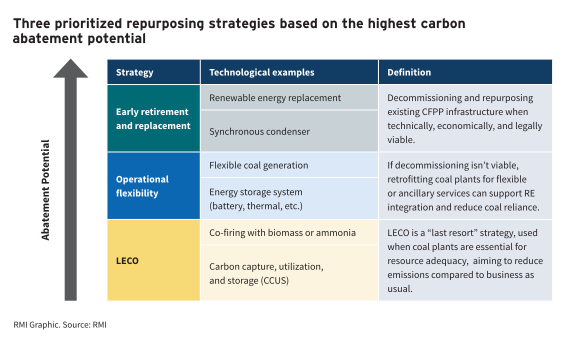
With Germany’s recent chairmanship of the International Partnership Group (IPG) and new leadership under the Government of Indonesia, the report proposes a strategic evolution. It outlines a fully integrated “coal-to-clean” framework that aligns JETP with Indonesia’s “move up the value chain” industrial ambitions — leveraging concessional finance to de-risk private investment in renewables; repurposing coal assets through early retirement, flexible operation, and selective lower emission cost output; and embedding workforce development and local-level ownership at the heart of a just transition.
Three Prioritized Repurposing Strategies Based on the Highest Carbon Abatement Potential
Download the full report to explore the recommendations for transforming JETP from a climate pledge into Indonesia’s engine for clean-energy-driven prosperity.



Related Insights


How Southeast Asia’s Low-Emission Chemicals Sector Can Expand

Help build the clean energy future. Donate today.
Independent research. Real-world solutions. Supported by donors.
RMI can pursue the highest-impact climate and energy solutions because we’re supported by people who believe change is possible. Every gift helps advance the work needed to make clean energy the default choice worldwide.
For other ways to give to RMI, including checks or gifts of stock, please visit Other Ways to Give.
