

Learn how we are working to transform how we use and produce energy.
Power Planning to the People
How Stakeholder-Driven Modeling Can Help Build a Better Grid
Why we share this work for free
RMI is an independent nonprofit working to accelerate the clean energy transition. We publish research like this to inform decision-makers and drive real-world impact.
Our work is supported by philanthropy as well as partnerships, including fee-for-service engagements. This support makes it possible for us to share our independent insights for free.
If you find this work valuable, you can support it anytime.
Get more insights like this
Stay up to date with the latest research, analysis, and tools from RMI by opting in to receive occasional emails below. You’ll get new reports, event invitations, and practical insights to help us all accelerate the clean energy transition.
Loading form...
Your download should start automatically. If it doesn’t, click the download button below.
This work is made possible by philanthropy
RMI is a nonprofit supported by donors and partners. Philanthropy enables us to produce independent research and make resources like this freely available.
If you find this report valuable, please consider supporting our work. You can also explore how we partner with organizations to drive impact.
Jump to Section
To promote transparency and allow interested readers to further explore our modeling assumptions, the workbook and data sources used to create our model inputs are available for download here. The full set of input files and associated code is available upon request by emailing the authors.
Integrated resource planning is getting more complex due to rapid technological change, new planning objectives such as emissions reductions, emerging state and federal policy, and increased stakeholder participation. Yet utilities nationwide have been slow to adopt new modeling tools and use their advanced features to help achieve more trustworthy and transparent planning outcomes while reducing costs for customers. A growing set of zero-cost, open-source planning models are creating new opportunities for nonutility stakeholders in the resource planning process — including ratepayer advocates and industry, environmental, and community advocacy organizations — to perform their own modeling.
In this report, we examine how stakeholder-driven modeling that leverages open-source utility planning software with transparent data and assumptions can lead to better planning outcomes. As a case study, we used GenX, a leading open-source tool, to independently explore key concerns raised by stakeholders in the 2021 resource plan filed jointly by the utilities Louisville Gas and Electric (LG&E) and Kentucky Utilities (KU). Our findings, which are summarized in Exhibit 1, reveal opportunities for near-term customer savings through cleaner least-cost planning pathways than those modeled by the utilities.
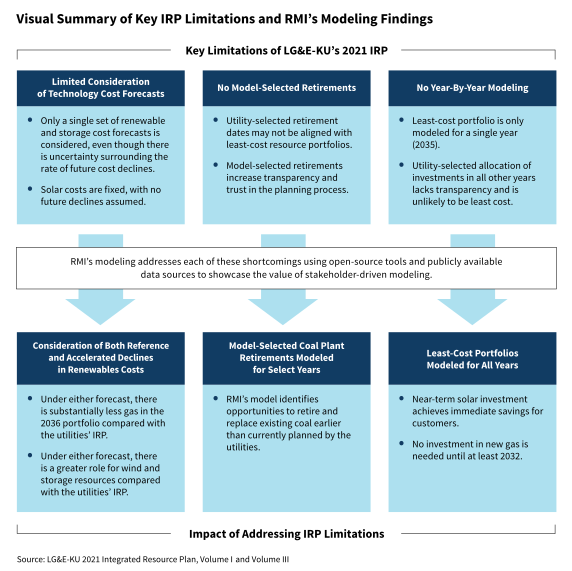
Regulators across the country have an opportunity to incorporate stakeholder-driven modeling in their decision-making to ensure more robust planning, and we suggest actions they can take that would empower stakeholders to complement utility-led modeling, including:
- Making industry tools and data sets more transparent and accessible, such as by establishing data-access standards so that inputs and assumptions used in utility modeling can be easily reviewed and analyzed;
- Establishing IRP rules that allow for stakeholder review and comment on the inputs and assumptions early in the planning process; and
- Reducing cost barriers to stakeholders by requiring utilities to fund stakeholder licenses for their proprietary models, or by signaling openness to zero-cost open-source models.
This report is a companion to RMI’s forthcoming report Reimagining Resource Planning (January 2023), which identifies a broader set of opportunities for making resource planning more trusted, comprehensive, and aligned with traditional and emerging objectives.



Related Insights

Reality Check: For Power Plants, Changing the Fuel Doesn’t Fix the Economics

The Opportunity for Heat Pumps to Put Downward Pressure on Electricity Rates

For Clean Energy Projects, How Community Benefits Are Delivered Matters
Tracking WestTEC: Where 100+ Transmission Projects Stand and What Comes Next
Help build the clean energy future. Donate today.
Independent research. Real-world solutions. Supported by donors.
RMI can pursue the highest-impact climate and energy solutions because we’re supported by people who believe change is possible. Every gift helps advance the work needed to make clean energy the default choice worldwide.
For other ways to give to RMI, including checks or gifts of stock, please visit Other Ways to Give.
