

Learn how we are working to transform how we use and produce energy.
Beating the Heat: A Sustainable Cooling Handbook for Cities
Why we share this work for free
RMI is an independent nonprofit working to accelerate the clean energy transition. We publish research like this to inform decision-makers and drive real-world impact.
Our work is supported by philanthropy as well as partnerships, including fee-for-service engagements. This support makes it possible for us to share our independent insights for free.
If you find this work valuable, you can support it anytime.
Get more insights like this
Stay up to date with the latest research, analysis, and tools from RMI by opting in to receive occasional emails below. You’ll get new reports, event invitations, and practical insights to help us all accelerate the clean energy transition.
Loading form...
Your download should start automatically. If it doesn’t, click the download button below.
This work is made possible by philanthropy
RMI is a nonprofit supported by donors and partners. Philanthropy enables us to produce independent research and make resources like this freely available.
If you find this report valuable, please consider supporting our work. You can also explore how we partner with organizations to drive impact.
Jump to Section
With growing populations and rapid urbanization, global warming impacts are felt most acutely in cities. Research shows that the world’s cities are heating up at twice the global average rate due to the urban heat island effect. Hotter cities could be catastrophic for public health and productivity, and the demand for cooling solutions is increasing. The energy requirements for space cooling are predicted to triple from 2016 to 2050 as millions of new households acquire air conditioners in the coming decades.
The effects of extreme heat are felt most by the poor who typically live in a city’s hottest neighborhoods and are the least likely to be able to afford or access air-conditioned spaces. Increased demand for space cooling could also drastically increase greenhouse gas emissions. Implementing a cohesive set of sustainable urban cooling interventions, on the other hand, can deliver far-reaching benefits. It can improve health and productivity, reduce energy requirements, lower emissions, and generate economic benefits. City officials working to make their cities cooler are faced with a wide range of solutions—the challenge is where to start.
Beating the Heat: A Sustainable Cooling Handbook for Cities, published by the United Nations Environment Programme in partnership with RMI, serves as an encyclopedia of sustainable urban cooling solutions—from city-wide scale down to the neighborhood, building, or household scale. The handbook focuses on a whole-system approach to cooling and guides cities on when, where, and how to apply these solutions for maximum benefit. Eighty supporting case studies and examples demonstrate the effectiveness of the strategies and can help cities find an approach best suited to their unique contexts. The guidance in this handbook should help elected officials, policymakers, planners, developers, and communities make progress towards sustainable and equitable urban cooling, while also cutting emissions and increasing resilience.
A Whole-Systems Approach Towards Sustainable Urban Cooling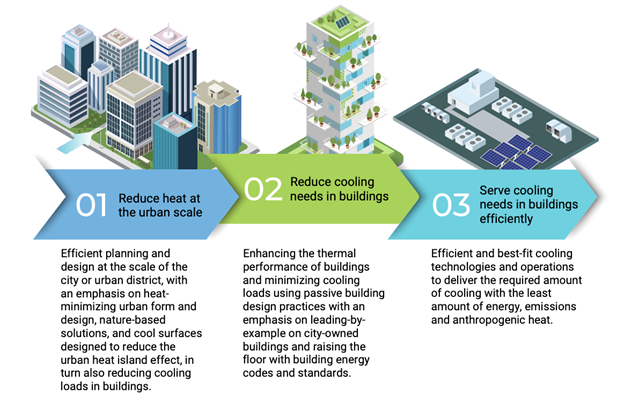
Click to download the Beating the Heat: A Sustainable Cooling Handbook for Cities here, or click the download button above.
Authors

Julia Meisel
Manager
Rushad Nanavatty
Managing Director
Mia Reback
Manager
Iain Campbell
Radhika Lalit
Sneha Sachar
Related Insights
Gas Utility Depreciation: Recommendations for an Uncertain Future



Help build the clean energy future. Donate today.
Independent research. Real-world solutions. Supported by donors.
RMI can pursue the highest-impact climate and energy solutions because we’re supported by people who believe change is possible. Every gift helps advance the work needed to make clean energy the default choice worldwide.
For other ways to give to RMI, including checks or gifts of stock, please visit Other Ways to Give.