

Learn how we are working to transform how we use and produce energy.
Mobilizing Finance for EVs in India
A Toolkit of Solutions to Mitigate Risks and Address Market Barriers
Why we share this work for free
RMI is an independent nonprofit working to accelerate the clean energy transition. We publish research like this to inform decision-makers and drive real-world impact.
Our work is supported by philanthropy as well as partnerships, including fee-for-service engagements. This support makes it possible for us to share our independent insights for free.
If you find this work valuable, you can support it anytime.
Get more insights like this
Stay up to date with the latest research, analysis, and tools from RMI by opting in to receive occasional emails below. You’ll get new reports, event invitations, and practical insights to help us all accelerate the clean energy transition.
Loading form...
Your download should start automatically. If it doesn’t, click the download button below.
This work is made possible by philanthropy
RMI is a nonprofit supported by donors and partners. Philanthropy enables us to produce independent research and make resources like this freely available.
If you find this report valuable, please consider supporting our work. You can also explore how we partner with organizations to drive impact.
Jump to Section
India’s transition to electric vehicles (EVs) has advanced rapidly in the past few years. A supportive policy environment, improving economics, and emerging business models have poised the EV market for significant growth in the coming decade.
Key barriers related to EV adoption—including technology cost, infrastructure availability, and consumer behavior—must be overcome. Our report Mobilising Finance for EVs in India: A Toolkit of Solutions to Mitigate Risks and Address Market Barriers highlights financing as another key hurdle to accelerating uptake. EV buyers currently face a range of financing challenges, such as high interest and insurance rates, low loan-to-value ratios, and limited specialized financing options. These challenges will only become more important to address as EV adoption picks up.
The quantity of capital and finance required for India’s EV future is considerable. Our analysis estimates that the cumulative capital cost of the country’s EV transition between 2020 and 2030 is 19.7 trillion rupees (approximately $266 billion) across vehicles, charging stations, and batteries. The projected size of the annual loan market for EVs in 2030 is 3.7 trillion rupees (approximately $50 billion).
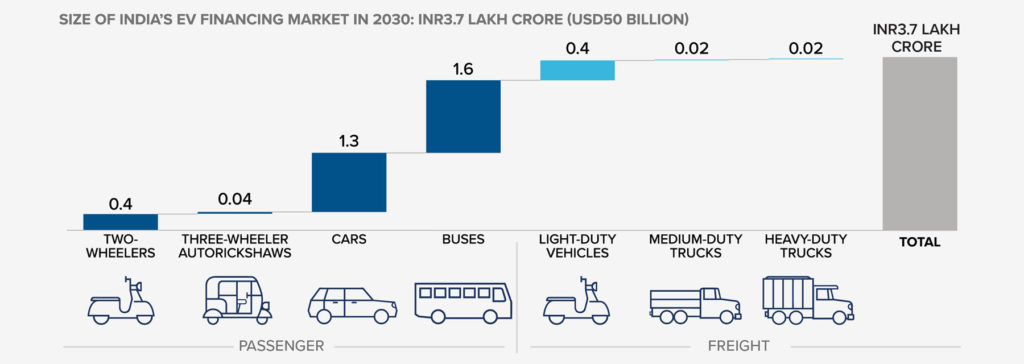
Considering the future capital and financing requirements for India’s EV transition, it is important to start developing solutions to enable finance for EVs today. NITI Aayog and Rocky Mountain Institute, with RMI India’s research support, have developed a toolkit of 10 solutions for government, industry, and financial institutions.
Contact the authors:
Ryan Laemel, RMI, at rlaemel@rmi.org
Isha Kulkarni, RMI India, at ikulkarni@rmi.org


Related Insights

India’s Used EV Battery Market Needs Trust. Battery Aadhaar Can Help.

Help build the clean energy future. Donate today.
Independent research. Real-world solutions. Supported by donors.
RMI can pursue the highest-impact climate and energy solutions because we’re supported by people who believe change is possible. Every gift helps advance the work needed to make clean energy the default choice worldwide.
For other ways to give to RMI, including checks or gifts of stock, please visit Other Ways to Give.
