

Learn how we are working to transform how we use and produce energy.
Why we share this work for free
RMI is an independent nonprofit working to accelerate the clean energy transition. We publish research like this to inform decision-makers and drive real-world impact.
Our work is supported by philanthropy as well as partnerships, including fee-for-service engagements. This support makes it possible for us to share our independent insights for free.
If you find this work valuable, you can support it anytime.
Get more insights like this
Stay up to date with the latest research, analysis, and tools from RMI by opting in to receive occasional emails below. You’ll get new reports, event invitations, and practical insights to help us all accelerate the clean energy transition.
Loading form...
Your download should start automatically. If it doesn’t, click the download button below.
This work is made possible by philanthropy
RMI is a nonprofit supported by donors and partners. Philanthropy enables us to produce independent research and make resources like this freely available.
If you find this report valuable, please consider supporting our work. You can also explore how we partner with organizations to drive impact.
Jump to Section
As cities in China go through economic transformation, they also face the challenges of carbon emissions, waste management, and pollution control. Many global cities face similar challenges. The global urban population is predicted to increase by 2.5 billion by 2050, and the main driver for the new round of urbanization is the global division of labor and industrial transfer. As a result, carbon emissions of emerging economies are often export-driven while waste and pollution remain a domestic issue. All three issues seriously affect the daily life of everyday people.
By tackling those three challenges together for the first time, Rocky Mountain Institute’s new report introduces a new concept — Whole-System Zero-Emissions Demonstration (WS-ZED). The WS-ZED concept goes one step further than net-zero carbon and proposes a broader concept to reveal the added value of synergy among net-zero carbon, net-zero waste, and net-zero pollution. This new concept aims to resolve these growth challenges by adopting a holistic approach to put in place urban management policies to combat both climate change and environmental degradation.
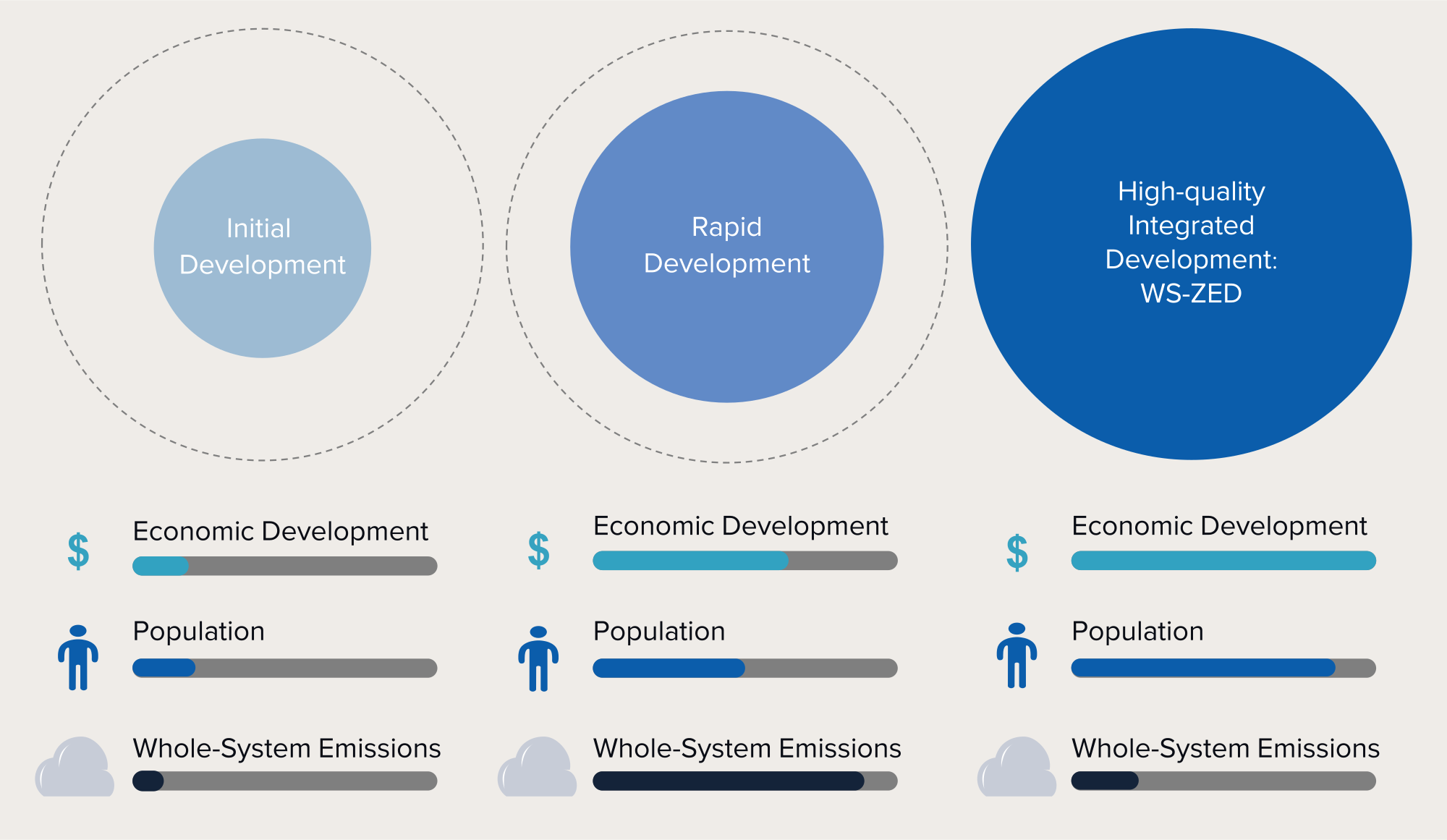
In the report, RMI proposes:
- A WS-ZED theoretical framework to elaborate the correlation between production/living and emissions/waste/pollution, establishing the internal logic for cross-sector efforts of mitigation, reuse, recycle, and treatment.
- A WS-ZED dual-indicator system to support planning decisions and emissions benchmarking, covering social/economic factors, planning and design decisions, production and living conditions, and resources/supplies.
- A WS-ZED technology landscape to support implementation of early intervention technologies, reshaping urban infrastructure to scale up clean energy, low-carbon industry, green mobility, efficient buildings, and other integrated city governance technologies.
Whole-System Zero-Emissions Demonstration is a China-originated concept with global vision, which we believe will set new benchmarks for global urbanization, especially for countries and regions experiencing rapid urbanization along with the Belt and Road Initiative.
Authors

Ting Li
Chief Representative and Managing Director of RMI China
Yihan Hao
Principal
Shutong (Lucy) Lu
Manager
Meng Wang
Manager
James Mandel
Koben Calhoun
Related Insights
Steel’s Transformation: China and Australia’s next horizon of clean steel
Efficiency Reimagined: The next phase of China’s industrial energy transition

Help build the clean energy future. Donate today.
Independent research. Real-world solutions. Supported by donors.
RMI can pursue the highest-impact climate and energy solutions because we’re supported by people who believe change is possible. Every gift helps advance the work needed to make clean energy the default choice worldwide.
For other ways to give to RMI, including checks or gifts of stock, please visit Other Ways to Give.
