

Learn how we are working to transform how we use and produce energy.
Exploring China’s Pathway to a New Power System: Bringing Modern Elements Online Before Phasing Out the Old
Why we share this work for free
RMI is an independent nonprofit working to accelerate the clean energy transition. We publish research like this to inform decision-makers and drive real-world impact.
Our work is supported by philanthropy as well as partnerships, including fee-for-service engagements. This support makes it possible for us to share our independent insights for free.
If you find this work valuable, you can support it anytime.
Get more insights like this
Stay up to date with the latest research, analysis, and tools from RMI by opting in to receive occasional emails below. You’ll get new reports, event invitations, and practical insights to help us all accelerate the clean energy transition.
Loading form...
Your download should start automatically. If it doesn’t, click the download button below.
This work is made possible by philanthropy
RMI is a nonprofit supported by donors and partners. Philanthropy enables us to produce independent research and make resources like this freely available.
If you find this report valuable, please consider supporting our work. You can also explore how we partner with organizations to drive impact.
Jump to Section
China has made a commitment to reach peak carbon dioxide emissions before 2030 and carbon neutrality by 2060. The power sector, which contributes about 40% of the country’s carbon emissions today, is at the heart of climate change solutions and the energy transition.
Recognizing the significance of power decarbonization, China officially rolled out its concept of a New Power System in March 2021, and the concept was later reinforced in top-level Chinese climate policy. The fast-changing global energy landscape added complexity to the discussion of the New Power System. With the 2022 global energy crisis and the domestic power crunch of 2021 and 2022, the thinking around the New Power System was adjusted to better balance short-term challenges and long-term ambitions.
Although stakeholders in China agreed that the New Power System was the key to the zero-carbon future, more detailed and concrete consensus beyond this concept were yet to be determined. This report is built on RMI’s in-depth research and observation, and a series of roundtable discussions with full involvement of key stakeholders in China’s power sector. The report aims to boost confidence and identify commonly agreed challenges and major approaches to support the establishment of the New Power System.
Gaining a comprehensive understanding of the power system is a fundamental step toward the New Power System in China. This report identifies four basic characteristics of the current power system:
- continued growth in electricity consumption
- resources dominated by coal
- renewable power sources concentrated far from load centers
- power market reform in progress
and concluded four major features of the New Power System:
- extensive and balanced development of green power
- large-scale energy storage as a source of flexibility
- digital technology and artificial intelligence to enable a smart electric power grid
- demand as an elastic participant in system balancing
Building the New Power System in China will not be achieved overnight: the process will be more like a marathon on an unpaved path. Exhibit below summarizes four main challenges to making a successful transition, eight core propositions for the New Power System buildup, and other key takeaways from the report.
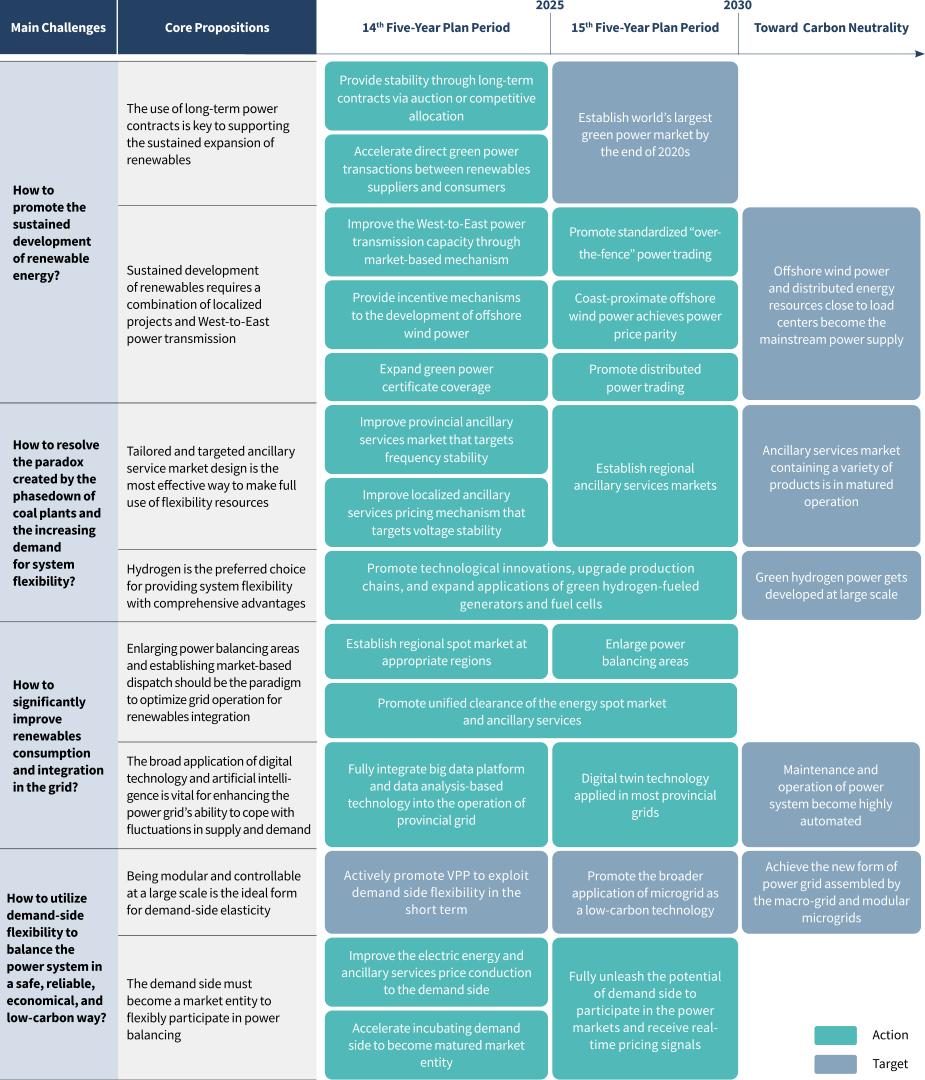
This executive summary report in English is an abridged version of the Chinese report released in December 2022, which can be downloaded from the RMI China website. This report helps align positions among different stakeholders and incentivizes collective efforts across the industry.
Authors

Shuo Gao
Manager
Qin Zhou
Yujing Liu

Ting Li
Chief Representative and Managing Director of RMI China
Ziyi Liu
Senior Associate
Yuan Yao

Zihao Chen
Senior Associate
Yiyuan Qi
Related Insights

Steel’s Transformation: China and Australia’s next horizon of clean steel
Efficiency Reimagined: The next phase of China’s industrial energy transition
Help build the clean energy future. Donate today.
Independent research. Real-world solutions. Supported by donors.
RMI can pursue the highest-impact climate and energy solutions because we’re supported by people who believe change is possible. Every gift helps advance the work needed to make clean energy the default choice worldwide.
For other ways to give to RMI, including checks or gifts of stock, please visit Other Ways to Give.
