

Learn how we are working to transform how we use and produce energy.
Scaling the Next Generation of Industrial Climate Solutions
Through the Future Industries Partnership, 18 startups are receiving support to scale climate technologies for heavy industry and the built environment across Asia and the Middle East
Why we share this work for free
RMI is an independent nonprofit working to accelerate the clean energy transition. We publish research like this to inform decision-makers and drive real-world impact.
Our work is supported by philanthropy as well as partnerships, including fee-for-service engagements. This support makes it possible for us to share our independent insights for free.
If you find this work valuable, you can support it anytime.
Get more insights like this
Stay up to date with the latest research, analysis, and tools from RMI by opting in to receive occasional emails below. You’ll get new reports, event invitations, and practical insights to help us all accelerate the clean energy transition.
Loading form...
Your download should start automatically. If it doesn’t, click the download button below.
This work is made possible by philanthropy
RMI is a nonprofit supported by donors and partners. Philanthropy enables us to produce independent research and make resources like this freely available.
If you find this report valuable, please consider supporting our work. You can also explore how we partner with organizations to drive impact.
Jump to Section
Third Derivative, RMI’s global climate tech accelerator, recently welcomed a new cohort, with 18 startups working to decarbonize heavy industry and the built environment across Southeast Asia, India, and the Middle East. Through the Future Industries Partnership, a philanthropic program supported by HSBC and delivered by Third Derivative and Founders Factory, these startups will receive technical and commercial support, along with curated introductions to investors and corporate partners, to help accelerate deployment and unlock financing in emerging markets.
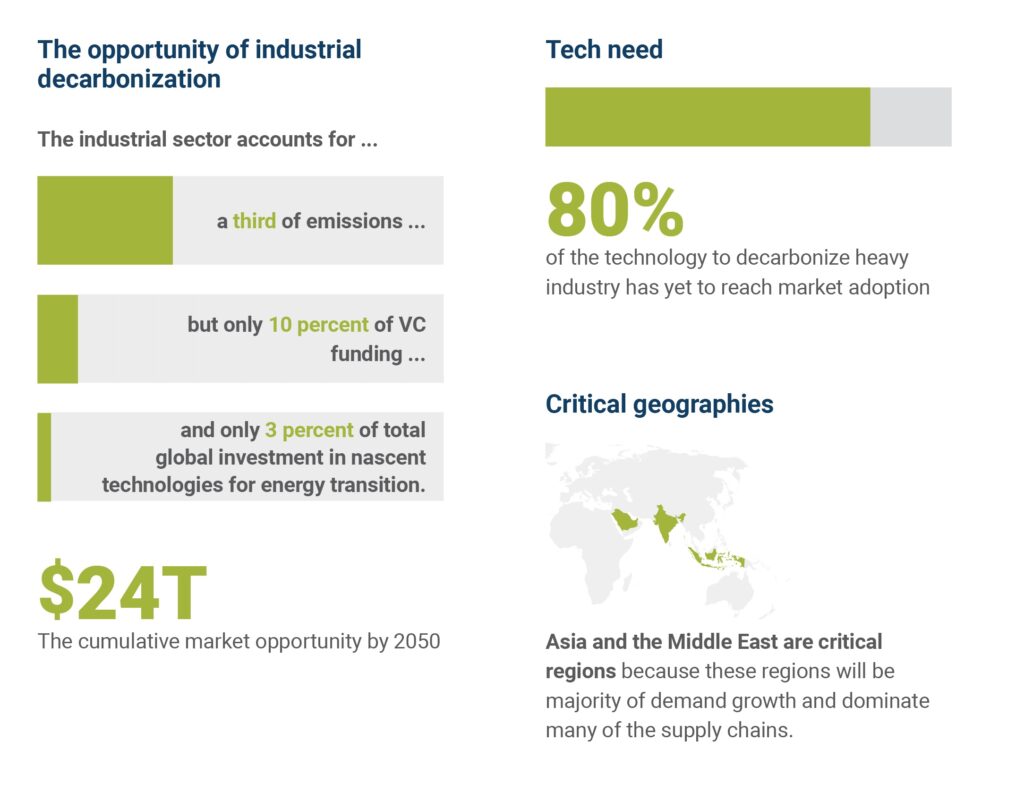
Heavy industry accounts for about 30% of global carbon pollution today, and without intervention could become the largest source of climate pollution within a decade. Across Asia and the Middle East, production of industrial commodities is rapidly increasing as these regions grow and expand economically. New technologies, particularly in heavy industry, require significant up-front capital and specialized skills to support development and deployment, and they face greater commercial and regulatory uncertainty. Much of the technology needed to decarbonize heavy industry has yet to reach market adoption.
The first 10 startups supported through the Future Industries Partnership joined Third Derivative’s portfolio in August 2025. Joining them this week are 18 more startups with industrial solutions across building materials, critical minerals, fuels, carbon management, and more.
Built environment
- Airform manufactures air-to-water heat pumps and batteries that can be installed by homeowners themselves and networked to provide significant demand flexibility as virtual power plants. Airform heat pumps can use CO2 as the refrigerant, which has a global warming potential orders of magnitude lower than incumbent refrigerants. This technology is also entering the market at a lower price point than traditional heat pumps.
- CarbonStrong refines industrial fly ash to create a more reactive, higher performing binder that can replace up to 40% of the cement in a concrete mix, compared to the 10%–20% replacement rate of raw fly ash, reducing both cost and carbon intensity. CarbonStrong’s drop-in solution is already code compliant and lower cost than traditional cement, enabling near-term impactin regions with very fast-growing concrete demand, like India.
- Climitra is helping steel producers in India decarbonize existing blast furnace assets with a drop-in bio-coal made from waste biomass. Designed to fit into current operations without major process changes or new infrastructure, the fuel can reduce emissions by about 90% while competing with incumbent Pulverized Coal Injection (PCI) coal on price. Climitra’s vertically integrated approach, from biomass intelligence and sourcing through pyrolysis and delivery, helps convert an underused feedstock into a valuable industrial input.
- Conry Tech is replacing large, centralized heating and cooling plants with a distributed network of compact, ultra-efficient, all-electric units that integrate heating, cooling, and sensing at the zone level. This decentralized approach can reduce energy consumption for heating and cooling by 70%, with the units delivering performance that is two to five times better than conventional systems. The modular design allows for quick and simple installation and easy repairs.
- CURA is producing a drop-in, zero-carbon lime that eliminates the largest source of cement emissions: CO2 released from limestone during calcination. CURA’s proprietary electrochemical process breaks down limestone (calcium carbonate) into lime (calcium oxide) — a key ingredient in cement — and a pure stream of CO2 ready for utilization or storage. Designed to work with existing cement infrastructure and supply chains, CURA targets one of the world’s hardest-to-abate sectors, with additional applications in steel, mining, chemicals, and carbon removal.
- PRISTINZ delivers advanced window solutions to reduce incoming thermal energy in buildings, targeting geographies like Indonesia that have high heat stress and cooling demand. It has three core technologies: a low-cost film to reduce indoor temperatures in existing buildings by 4-9°C, a laminated glass for new buildings that rejects heat, and a transparent photovoltaic window that functions as vertical solar power. These solutions target the wavelengths of light responsible for tropical heat gain while allowing visible light to pass through, unlike traditional coatings that typically only target UV and visible light. They are also designed to fit into existing glass production lines, enabling scale without requiring new manufacturing infrastructure.
- Uravu Labs converts low-grade waste heat, prevalent in data centers and industrial facilities, into cooling and distilled water. Its modular liquid desiccant technology can integrate into existing or new facilities and can reduce cooling costs by up to 60% while producing up to 30 m³ of water per megawatt per day on site. Ambient air passes through the desiccant, which absorbs moisture and regenerates using waste heat. This separates dehumidification from cooling, boosting the efficiency of cooling equipment while producing distilled water.
- Widuz is developing low-carbon engineered bamboo materials that can replace conventional wood products, as well as certain steel and concrete applications, across furniture, interiors, and building components. Its core innovation is a patented manufacturing process built around scalable micro-factories, enabling higher-performance bamboo products while reducing transport, energy, and up-front capital costs.
Carbon and methane management
- beyond captur is developing a fully electric direct air capture (DAC) system using a novel electro-swing technology, which uses small voltage changes to capture and release CO2, eliminating the thermal energy and solvents typically required in other DAC systems. This approach aims to enable a DAC pathway that is modular and stackable, compatible with renewable energy, and potentially lower cost than existing technologies at scale, overcoming many of the barriers to DAC deployment.
- Bhumi is a collaborative digital monitoring, reporting, and verification (MRV) platform that accurately tracks and quantifies the collection, transport, and safe destruction of gas refrigerants with climate pollution impact over 2,000 times greater than CO2. Life-cycle refrigerant management is a vast and untapped opportunity with a very high ceiling for climate impact, especially given the projected growth of air conditioning and other industrial cooling applications globally, and it could help prevent billions of tons of greenhouse gases from entering the atmosphere by 2050.
- Mitti Labs is reducing methane emissions from agriculture, especially rice farming, by helping farmers adopt water management practices like alternative wetting and drying, which requires no new capital expenditure. Mitti’s rice-specific digital MRV currently shows ~95% accuracy and is backed by field validation to address historic quality issues in traditional rice-based credits. This strategy targets a large but underserved methane mitigation opportunity with a scalable, cost-effective solution that combines field execution with credible, higher confidence digital MRV.
- Varaha ClimateAg develops large-scale carbon removal projects with smallholder farmers across South Asia, deploying pathways such as regenerative agriculture, afforestation, biochar, and enhanced rock weathering to monetize verified carbon removal through the voluntary carbon market. Unlike single-pathway nature-based carbon removal projects, Varaha combines a portfolio of solutions to balance durability, impact, and verification confidence. This approach combines a science-backed MRV platform with large-scale on-the-ground deployment, enabling high-integrity carbon removal with smallholder farmers.
Chemicals and fuels
- Electrogenos is making green hydrogen more affordable with a next-generation alkaline electrolyzer designed to reduce cost without compromising efficiency. Using a patented catalyst that delivers three times the activity of traditional platinum-based electrolyzers at just 1/50th the cost, the company has achieved a stack cost of $85/kW, beating current competitive electrolyzer stack costs, while still delivering up to 98% higher heating value efficiency.
- GREE Energy is reducing fugitive emissions from waste biomass in Indonesia by converting this abundant waste stream into usable low-carbon energy. The bio-LNG project developer uses a hub-centric model to scale biogas facilities co-digesting palm oil effluent and empty fruit bunches, which currently produce a significant amount of fugitive emissions. To date, it has been difficult to utilize all of the biomass potential in Indonesia, largely due to complex logistics, lack of infrastructure, and long-distance transportation emissions. GREE has demonstrated a credible model for putting more of this biomass to productive use by overcoming existing barriers with on-site co-digestion, resulting in a potential near-term environmental win for the region and source of low-carbon electricity.
- Ossus Biorenewables converts organic matter present in industrial and municipal wastewater in India directly into hydrogen, while also treating the wastewater for the customer. The company’s bio-electrochemical reactor only uses up to 3 kWh to produce 1 kg of hydrogen, avoiding approximately 7 kg of CO2 per kg of hydrogen produced compared to traditional grey hydrogen production in India. The levelized cost of hydrogen for this process is already competitive with grey hydrogen and less than half the cost of current green hydrogen in the region.
Industry and critical minerals
- BANIQL is developing an iterative leaching process for the refining of low-grade nickel ore that reduces costs and eliminates the environmental harms of current extraction methods. Nickel is a key critical mineral for a variety of industries vital for the energy transition, with large demand across key sectors like stainless steel and battery materials. Right now, battery costs are dominated by nickel and cobalt extraction, with these cathode materials accounting for up to 50% of battery costs. At scale, BANIQL could reduce the cost of nickel by 25%–50%, enabling significant reduction in the cost of high-performing lithium-ion batteries.
- Nanoweave is converting agricultural biomass into carbon-negative industrial cellulose, one of the most widely used materials in the world today, via a novel process that is largely feedstock agnostic and potentially highly profitable. Nanoweave’s low-temperature, plasma-assisted technology electromechanically separates cellulose from other components of woody tissue in agricultural waste from industries like palm oil and sugarcane. This pathway can turn these abundant waste streams from an environmental and economic liability into a valuable product, solving a key pain point for agricultural producers.
- Neutreeno helps manufacturers cut supply chain emissions, energy use, and costs by making Scope 3 emissions far more measurable and actionable. Historically, one of the major challenges for corporations addressing their Scope 3 supply chain emissions has been visibility, and conventional measurement tools are often too costly to scale or too inaccurate to act on. Neutreeno’s physics-based platform maps out industrial supply chains with a high degree of accuracy, enabling companies to identify emissions hotspots and act on efficiency improvement opportunities with 90% less data required than traditional LCA methods, significantly lowering the barrier to supplier adoption.
These startups reflect the variety of innovative technologies needed to decarbonize industry and the built environment in rapidly growing regions across India, Southeast Asia, and the Middle East. Scaling these innovations requires not just capital, but targeted interventions to unlock expertise, strategic partnerships, and systemic enablers. Learn more about Third Derivative’s entire portfolio at https://www.third-derivative.org/portfolio.
Sign up for Third Derivative's newsletter
Receive the latest updats on Third Derivative's program and portfolio

Authors

Sal Brzozowski
AssociateRelated Insights
Turning Buyer Demand into Lower-Emissions Copper Production


How Southeast Asia’s Low-Emission Chemicals Sector Can Expand
Help build the clean energy future. Donate today.
Independent research. Real-world solutions. Supported by donors.
RMI can pursue the highest-impact climate and energy solutions because we’re supported by people who believe change is possible. Every gift helps advance the work needed to make clean energy the default choice worldwide.
For other ways to give to RMI, including checks or gifts of stock, please visit Other Ways to Give.
