

Learn how we are working to transform how we use and produce energy.
The Rural Equitable Climate Transition toward Carbon Neutrality and Shared Prosperity
Framework, Index, and Outlook in China
Why we share this work for free
RMI is an independent nonprofit working to accelerate the clean energy transition. We publish research like this to inform decision-makers and drive real-world impact.
Our work is supported by philanthropy as well as partnerships, including fee-for-service engagements. This support makes it possible for us to share our independent insights for free.
If you find this work valuable, you can support it anytime.
Get more insights like this
Stay up to date with the latest research, analysis, and tools from RMI by opting in to receive occasional emails below. You’ll get new reports, event invitations, and practical insights to help us all accelerate the clean energy transition.
Loading form...
Your download should start automatically. If it doesn’t, click the download button below.
This work is made possible by philanthropy
RMI is a nonprofit supported by donors and partners. Philanthropy enables us to produce independent research and make resources like this freely available.
If you find this report valuable, please consider supporting our work. You can also explore how we partner with organizations to drive impact.
Jump to Section
As the recent global health crises, regional conflicts, and growingly frequent extreme weather events exacerbate energy and food insecurity especially for the underprivileged communities across the world, the need for an equitable transition toward carbon neutrality is more urgent than ever. China’s rural areas are particularly crucial for the country’s equitable transition. Feeding nearly one-fifth of the world’s population with only 9 percent of the world’s arable land, and home to 500 million people who still live on less than half of the income of those in cities, rural China amplifies the need to ensure equity in the process of development while also avoiding emissions lock-in.
Rural land possesses the vast majority of the nation’s renewable energy endowment and natural carbon sinks; while at the same time, rural areas and agricultural production are especially vulnerable to climate risks. This means that climate actions — such as renewable development, natural carbon conservation, and climate adaptation — in rural areas, if carried out in an equitable and inclusive manner, offer unique opportunities to advance rural development. Therefore, an equitable climate transition in rural China is important not only to the nation’s climate ambitions but also to its aspirations of common prosperity for all.
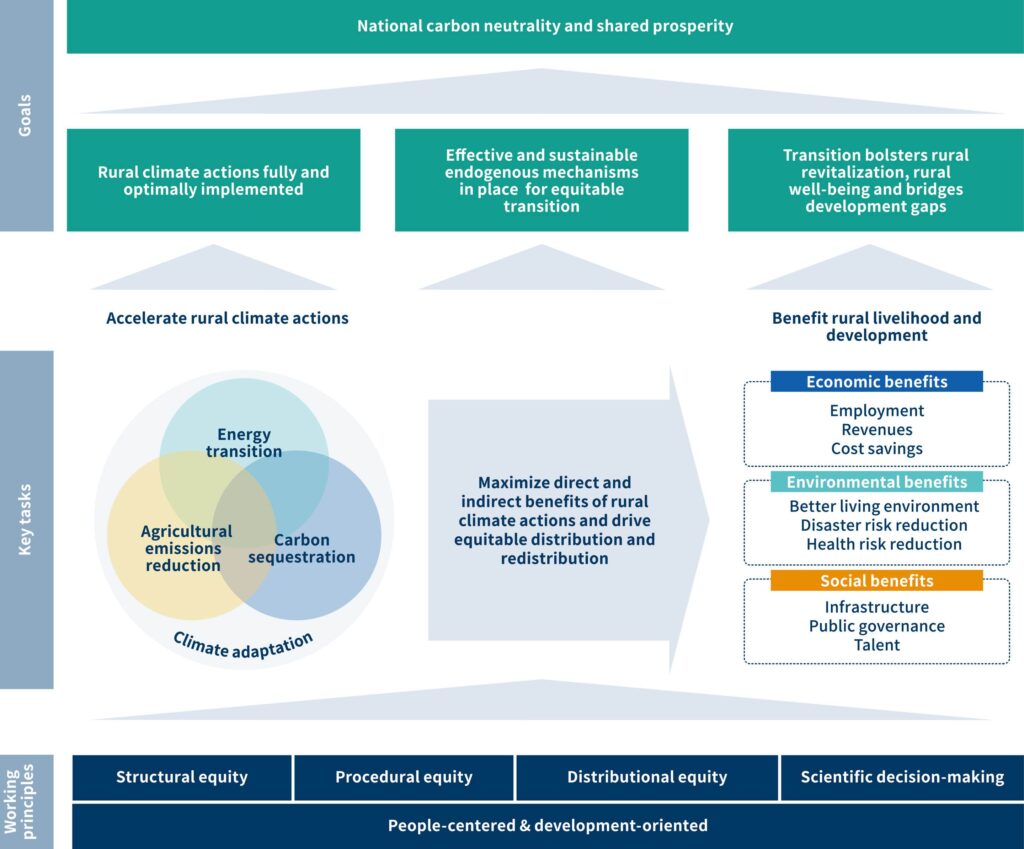
Therefore, we believe it is crucial to mainstream principles and frameworks of a rural equitable climate transition (Exhibit 1) including safeguarding food security and ensuring the right to sustainable development for all, especially relatively disadvantaged groups such as smallholder farmers. At the same time, climate actions should be leveraged to create social, environmental, and economic benefits that are distributed in an equitable way to help improve the well-being of rural residents and narrow urban-rural development gaps.
Built upon this framework, the report further introduces the Rural Equitable Climate Transition Index Tool, which provides a provincial-level landscape of the current status and future potential of carbon neutrality and equitable development in rural China, to inform policy coordination, investment decision-making, technological innovation, and institutional design.
Exhibit 1: Rural Equitable Climate Transition Framework
The index results reveal that regions with larger rural development gaps often are of greater significance for national food security, and most of these regions happen to be richer in renewable energy resources and carbon sinks but face less advanced innovation and investment environment. This suggests huge potential for advancing rural revitalization and narrowing development gaps through climate actions, and provides insights on sectoral and region-specific as well as cross-cutting opportunities and action points to accelerate an equitable transition for rural China.
The results also highlight differing emissions sources and intensities across geographies due to objective factors of residential energy use and agricultural production patterns, underlining the importance of customizing decarbonization pathways according to local situations. Based on this analysis, the report provides a set of policy recommendations, as well as six case studies to inform future actions of the rural equitable climate transition in China.




Related Insights

Steel’s Transformation: China and Australia’s next horizon of clean steel

Efficiency Reimagined: The next phase of China’s industrial energy transition

Help build the clean energy future. Donate today.
Independent research. Real-world solutions. Supported by donors.
RMI can pursue the highest-impact climate and energy solutions because we’re supported by people who believe change is possible. Every gift helps advance the work needed to make clean energy the default choice worldwide.
For other ways to give to RMI, including checks or gifts of stock, please visit Other Ways to Give.